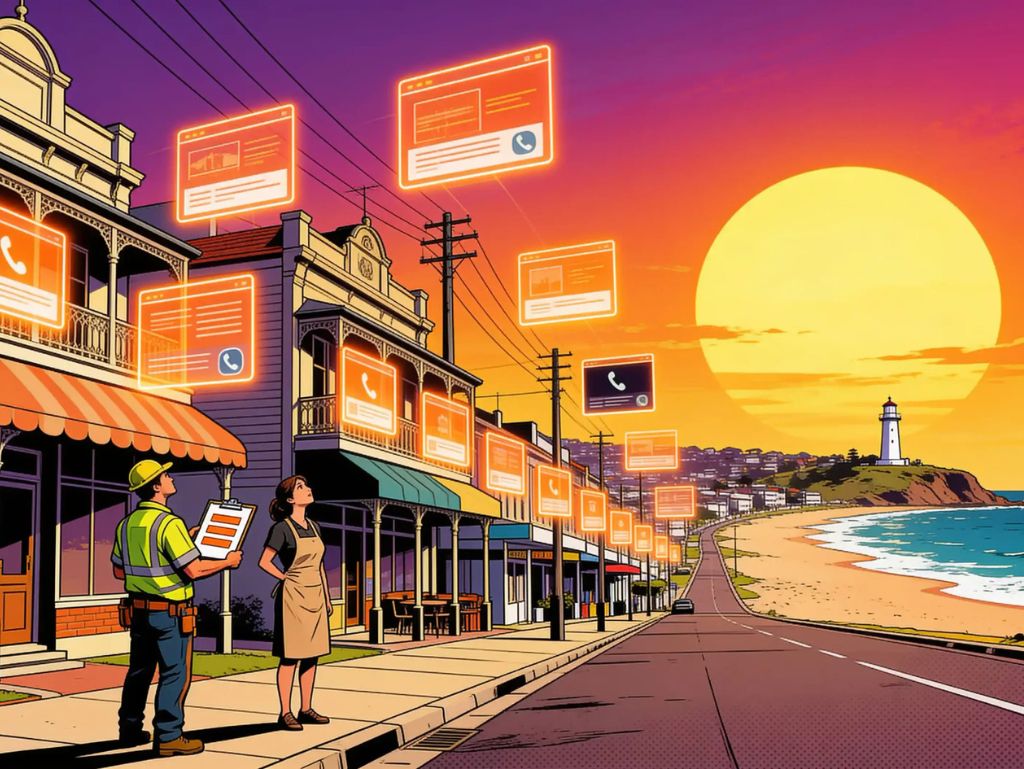
Every visitor to a local business website arrives with one question, and it is nearly always the same one: Do you do this, where I am, and can I get you now?
I build websites for businesses across Newcastle and the Hunter, and most of the sites I am asked to replace fail that question in the first five seconds. Not because they look bad. Usually they look fine. They fail because they were written for the business owner, not for the person searching.
Here is what I mean. A plumber in Maitland gets a site with a hero image, a line about quality workmanship, and a Services page that lists what they do. Nowhere does it say Maitland, or Rutherford, or East Maitland, or Thornton. Google has no idea where the business works, and neither does the person searching from Thornton at nine on a Sunday night with water coming through the ceiling.
The Hunter makes this harder than most regions. It is not one city with suburbs. It is Newcastle, Lake Macquarie, Maitland, Cessnock and Port Stephens: five council areas with their own town centres and a couple of hundred named localities between them. Someone in Belmont does not search “plumber Newcastle”. They search “plumber Belmont,” and Google shows them the businesses it can place in Belmont. A site that only says Newcastle is invisible to most of the region it serves.
So the first thing I look at on any Hunter site is whether the suburbs are on it. Not in a list in the footer, which Google discounts, but as real pages: a page for Belmont that says what you do in Belmont, how far out you go, and what the job usually involves there. Ten of those, written properly, will outrank a home page with a thousand words about why to choose you.
The second thing is the phone number. On a phone screen it should be tappable, in the top corner, on every page. It sounds obvious. On about half the sites I audit it is an image, or a line of text buried on the Contact page, or gone on mobile because the header collapsed.
The third thing is newer, and it is the one most business owners have not heard about yet. A growing share of local search now happens inside ChatGPT, Google’s AI Overviews and similar tools. When someone asks “who does gutter cleaning around Charlestown,” the answer is assembled from websites the AI can read and trust. A site built as one long scrolling page with the words baked into images, or hidden behind a script, gives it nothing to work with. Plain headings, real sentences, the suburbs named, the services named: that is what gets a business quoted.
None of this needs a rebuild. Pull up your own site on your phone, search inside it for your suburb, and try to ring yourself. If any of the three fail, that is your first fix, and it is usually the cheapest one on the list.
The businesses that get the phone ringing in the Hunter are rarely the ones with the flashiest site. They are the ones whose site answers the question the customer arrived with, in the suburb the customer is standing in.
IMAGE | The one question every Hunter customer asks your website