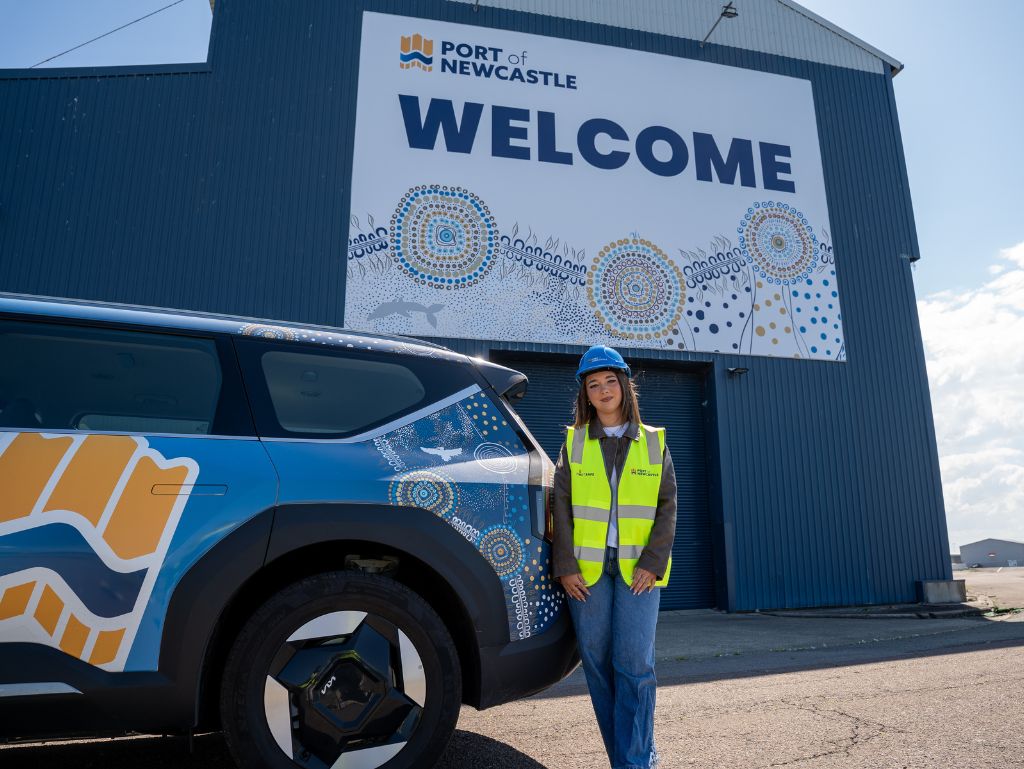
Port of Newcastle has updated its prominent waterfront billboard at Dyke Point, unveiling an artwork installation by emerging Indigenous artist Alliyah Bromell to welcome maritime visitors and seafarers to Newcastle Harbour. Titled Ties between water and land, the original piece explores the physical and cultural connections between the port infrastructure, river systems, local community and Traditional Owners, the Awabakal and Worimi People.
The eight-metre-high sign replaces a previous installation by Indigenous artist Saretta Fielding, which stood at the harbour landmark since 2020. Located on the blue storage sheds at Dyke Point, the installation is situated along the main shipping channel, providing high-visibility exposure to more than 2,300 commercial vessels, 40,000 international seafarers, and thousands of cruise ship passengers visiting Port of Newcastle annually.
Alliyah Bromell, a Kamilaroi woman living and working across Wonnarua, Worimi, and Awabakal land, originally created the piece for Port of Newcastle’s Wharf Road headquarters. The artwork has since been integrated into the organisation’s Innovate Reconciliation Action Plan (RAP) materials and incorporated into the port’s corporate electric vehicle fleet.
ESG and Sustainability Manager at Port of Newcastle, Ruth Madden stated that featuring local First Nations art reinforces the port’s broader commitment to regional cultural and environmental outcomes.
“Saretta Fielding’s artwork has welcomed seafarers and visitors since 2020, and its story has been an important part of this highly visible harbour landmark,” Ruth said.
“When it came time to renew the sign, we wanted to give Alliyah’s work the same prominent place to share its story of connection between the port, the water, and the community. The Port is committed to the social, economic, and environmental outcomes of this region, so we are honoured to be able to feature the work of an incredible, local Indigenous artist like Alliyah at such a recognisable waterfront location.”
Artist Alliyah Bromell added that displaying the piece along the active harbour corridor gives regional Indigenous culture a high-profile platform.
“For me, the artwork is about the way water and land connect us to place and to each other,” Alliyah said.
“The flowing lines tell the story of the sand, river and sea, while the water holes and meeting circles signify the ties between the community and the traditional owners of the land in which the harbour sits. It means a lot to share that story through a sign that will be seen by thousands of people each year.”
IMAGE | Alliyah Bromell with PON artwork